
Trump's Housing Ban: Let’s take a closer look
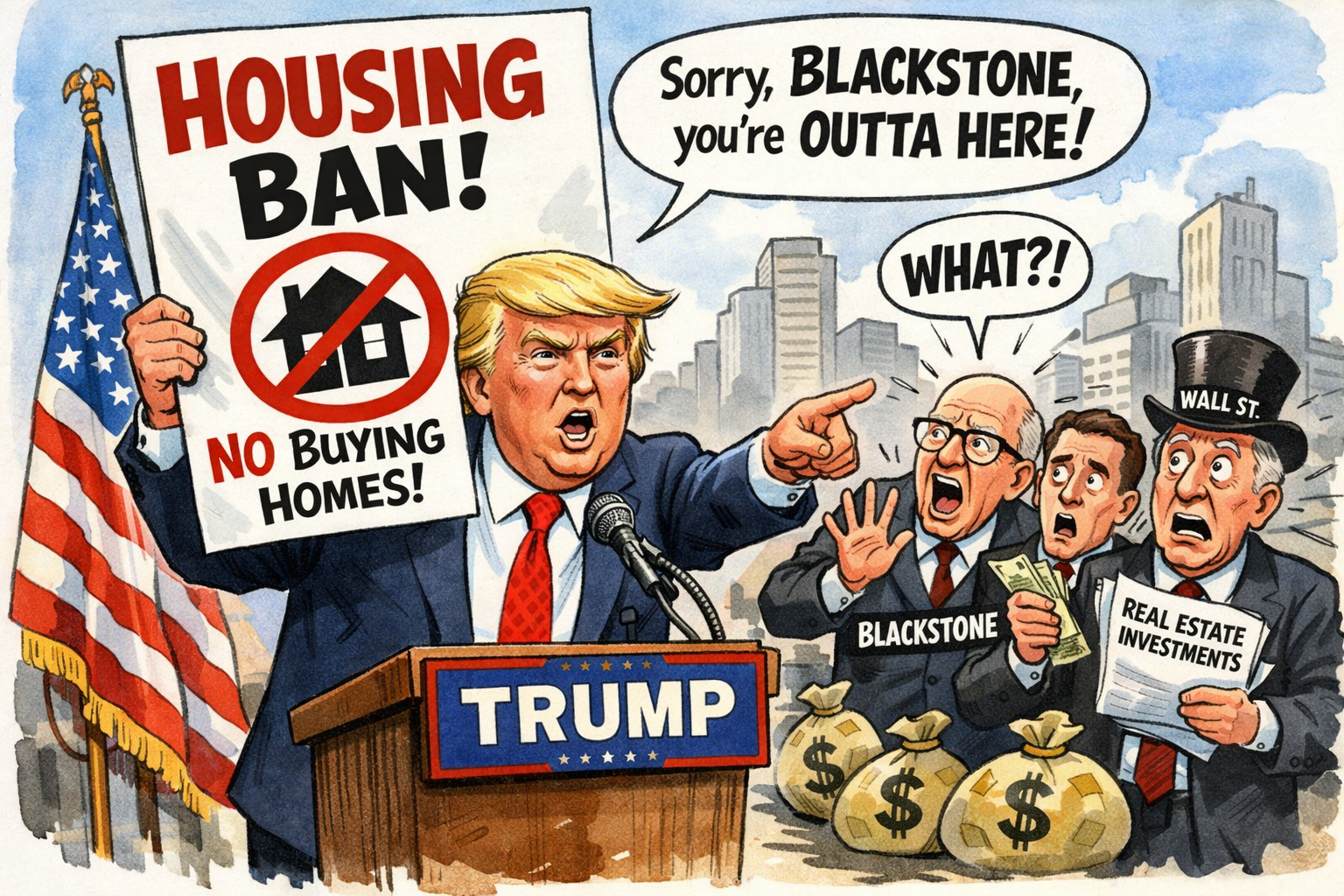
The announcement
On January 7th, President Trump announced he's "immediately taking steps to ban large institutional investors from buying more single-family homes." Blackstone initially dropped 9% before recovering.
He's announcing this ban days before speaking at Davos to the very institutional investors he's threatening. Whether it’s classic political theater ahead of November 2026 or something more is still to be seen. Regardless, there seems to be genuine bipartisan consensus that housing is broken (supported by the numbers below).
What the numbers say (to set context)
Trump's targeting institutional investors who own 1% of single-family housing stock nationally. In hot markets like Atlanta, it can reach an estimated 3 - 5%.
More data points:
First-time homebuyers: 50% of market (2010) → 24% (2024)
Median home price: +55% since 2020
75% of US homes unaffordable for most Americans
Why this is a conversation worth having
Institutional investors have structural advantages individual buyers can't match. They can offer all-cash, close in days, waive contingencies. Juxtapose this against a young family needing to secure financing and requiring reasonable conditions (such as an inspection) for what is the biggest financial decision of their life.
Worse, institutions prudently tend to operate with concentration strategies. Once they identify a high-potential neighbourhood, they buy aggressively — often multiple homes on the same block. Each purchase pushes up comparable sales, which justifies higher offers on the next property. It's a localized price spiral that regular buyers fund through higher mortgages while getting priced out themselves.
In neighbourhoods where institutional ownership hits 15-20%, this isn't simply abstract economic theory.
So, yes, “banning” institutional buyers (leaving definitional arguments aside) should provide some pricing relief all else equal. That's real, and it explains the political appeal. For those interested in reading more, https://www.gao.gov/assets/870/869193.pdf
But even if some sort of “ban” can be enforced (which is definitely possible)...
We're still fighting a massive supply problem. Goldman Sachs says we need 3-4 million additional homes beyond normal construction rates to stabilize prices. This is both a stock AND a flow argument. Simply put, we need more homes. And, yes, taking Institutional investors out of the SFH equation will likely impact new developments at the margin. That’s a totally fair counter argument. But won’t institutional investors pushed out of SFR reallocate to multi-family, which will also boost overall supply (perhaps more efficiently). Or, better yet, is there potential for institutions to reallocate capital to infrastructure that can create the conditions to build more, better and faster (capital to support the industrialization of housing)? There is relatively limited data / research out there comprehensive enough to take into consideration all of the puts and takes.
We’re interested in your thoughtful feedback. We love this debate because there are compelling ideas on both sides. But just a heads up, don’t @ us with the argument that institutional investors are only a small part of the market and therefore don’t influence prices. Anyone that’s spent 2 minutes investing in stocks knows that flows (marginal buyers) set price.
For now, we’re biased toward supporting a graduated tax on institutional SFR portfolios vs. an outright ban and perhaps introducing reporting requirements that essentially discourage institutional investment without the bluntness of a “ban.” There is something morally troubling about the crowding-out of young families and first-time home buyers, especially as more and more power has accrued to capital vs. labor.
Either way, we need to get building and we need to encourage investment in the infrastructure to support the modernization of the housing industry. That Trumps everything.