
More Units Isn’t Enough: Densifying Housing Also Requires Building Communities
Imagine moving into a new condo tower with a short commute — then discovering your child’s nearest school has a waitlist, the nearest park is a 20-minute walk, and your community centre hasn’t expanded in years. You’re in one of the densest postal codes in the country, and you still feel on your own. This is the quiet contradiction at the heart of Canada’s densification push.
We’re Building Units. Are We Building Neighbourhoods?
Densification is necessary — more homes mean better land use, shorter commutes, and lower carbon footprints. But between the pro-density consensus and approved development applications, a crucial question keeps getting skipped: what happens to the community once the cranes leave? A home isn’t just a unit. It’s a school catchment, a library walk, access to a doctor. These are the social connective tissues that turn towers into real neighbourhoods — and most densification policy treats them as someone else’s problem.

North York: The Case Study We’ve Been Handing Ourselves
Toronto’s North York at the Centre plan envisions the Yonge-Sheppard corridor’s population growing from 64,000 to 170,000 over 25–30 years — nearly three times today’s residents. The City’s Community Services and Facilities Strategy identifies the need for up to eight new elementary schools, three secondary schools, 2,077 new child care spaces, and 13,000 square metres of community agency space. What this document reveals is how far behind we already are before a single new building breaks ground.
This isn’t unique to North York — it’s a national pattern. In Willowdale, parents were sounding the alarm as early as 2017, with local schools past capacity. A 2024 Ontario Financial Accountability Office report found 84.1% of TDSB buildings below their state of good repair. We’re not simply short on schools; we’re short on the right schools in the right places at the right time.
The Cities That Got It Right Built Community First
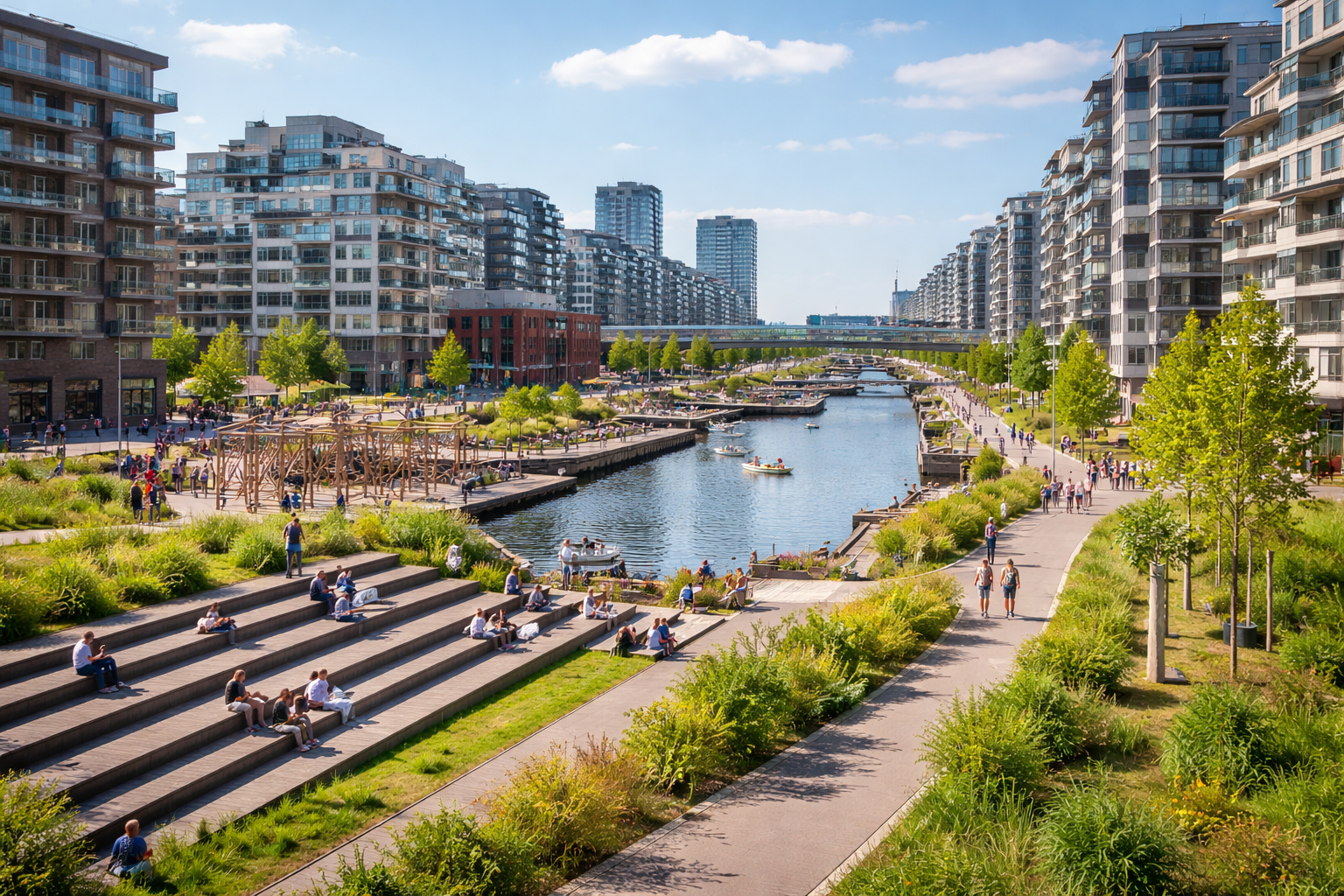
Singapore’s Punggol Eco-Town, planned for 200,000 residents, succeeded because of sequencing: MRT lines were built alongside the first housing blocks, with schools, parks, and retail planned concurrently. When early residents flagged insufficient amenities, the government accelerated investment rather than simply approving more towers. Copenhagen’s Nordhavn followed the same philosophy, integrating transit, cycling, and community space as structural requirements. Medellín, Colombia went further — building cable car transit to hillside settlements, then adding libraries, schools, and plazas, producing measurable reductions in both violence and poverty. The throughline is consistent: infrastructure investment preceded or ran alongside population growth.
The Cost of Getting This Wrong
Densification without community infrastructure undermines the very goals it was meant to achieve. European studies show that where green spaces are crowded out by new development, community acceptance of density collapses. When communities lack services families need, those with a choice leave — and those who stay face housing less affordable than before. Density without amenity doesn’t produce vibrant urban life; it produces congestion, strain, and political backlash that makes the next densification proposal harder to approve.
Affordability Can’t Be an Afterthought Either
Building more units and better communities only solves half the problem if the people who need them most can’t afford to live there. A neighbourhood with excellent schools, parks, and transit becomes an expensive one — and without deliberate affordability planning, community investment can accelerate displacement. We need mixed-income housing requirements, long-term rent protections, and below-market units woven through new developments. Singapore’s Punggol wasn’t just well-timed — it ensured residents across income levels could access the community being built. Canada’s densification agenda needs an equivalent commitment.
Build the Units. Build the Neighbourhood.
Canada’s densification agenda is right on principle. But a building permit is not a community, a floor plan is not a school, and a market-rate condo is not an affordable home. The harder work is turning inventory into a coordinated, funded, time-bound delivery plan — one that addresses affordability alongside infrastructure and keeps pace with the towers going up. The model exists. Singapore built it. Copenhagen built it. Medellín built it under far harder circumstances. The question isn’t whether we can afford to build communities alongside housing. It’s whether we can afford not to.